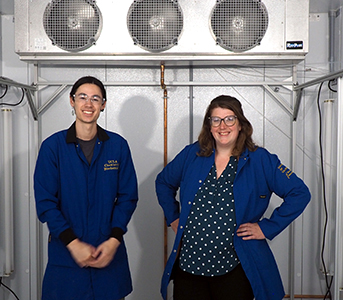
Professor Victoria Barber and doctoral student Cooper Crabtree are spearheading Keck Foundation-funded project charting a path toward better understanding atmospheric oxidation.
by Álvaro Castillo, UCLA College
From the vantage point of Victoria Barber, a UCLA assistant professor of chemistry and biochemistry, understanding the chemical reactions that shape air quality and climate are among the most pressing scientific challenges of our time.
And thanks to a recent grant from the W.M. Keck Foundation, she and doctoral student Cooper Crabtree will spearhead a new research project exploring exactly how pollutants form in the atmosphere.
Specifically, the project will examine how volatile organic compounds transform through atmospheric oxidation and explore how pollutants, like smog, form in the atmosphere. VOCs are released by sources ranging from trees and wildfires to vehicle exhaust pipes and consumer products such as cologne and perfume. As they undergo atmospheric oxidation, they can transform into a wide range of other compounds.
Anyone in Southern California can attest to the urgency of this area of research — for example, in late July of this year, Los Angeles County was under an active ozone pollution advisory for almost a full week. While many people associate ozone with the protective ozone layer high in the stratosphere, ground-level or tropospheric ozone is a harmful secondary pollutant formed through atmospheric oxidation. Understanding how VOCs transform into pollutants like ozone is therefore critical to improving air-quality forecasts and informing strategies to reduce exposure.
“My group is focused on trying accelerate our understanding of these networks of reactions so that we can do a better job of predicting how those pollutants form,” Barber said. “When we make decisions about how we might alter emissions, we can understand how that’s going to influence the production of these downstream pollutants.”
With support from the W. M. Keck Foundation, Barber and Crabtree are developing new experimental approaches that will combine — and improve — techniques to study hundreds of chemical systems more efficiently than traditional methods allow. Instead of spending years decoding a single VOC, the project seeks to dramatically expand the pace and scale of discovery.
The grant comes at a particularly important moment for environmental research. Barber, who joined UCLA in 2023, says funding for climate and air-quality research, especially for early career scientists, has become increasingly difficult to secure, a challenge compounded for ambitious projects that require building entirely new research infrastructure. The Keck Foundation’s support, Barber said, provides the flexibility to pursue bold early-stage, high-risk ideas that may be more difficult to fund using conventional federal funding sources.
“It’s really, really hard to do environmental research under the current federal paradigm,” Barber said. “By stepping in and providing stable and flexible funding to explore this new idea, the Keck Foundation is making a huge difference to my research program.”
In addition to funding early-career faculty, the Keck Foundation’s support is also focused on empowering graduate students like Crabtree in their scientific growth.
The project gives Crabtree the opportunity to help develop an entirely new experimental approach to studying atmospheric chemistry — an experience that will provide him with valuable technical skills, scientific training and preparation for the next stage of his career.
Stable funding also allows doctoral students like Crabtree to devote themselves more fully to research rather than balancing their scientific work with additional teaching responsibilities needed to cover funding gaps.
“Getting to devote more of my time to research this past school year has greatly improved the pace and quality of our experiments, data analysis and planning for our future work,” said Crabtree, who is pursuing a Ph.D. in chemistry. “I feel very lucky — especially amid the current uncertainty surrounding scientific funding — to be able to continue exploring exciting knowledge gaps in our field and growing as a scientific researcher.”
For Barber, mentorship is among the most rewarding and important aspects of her role as a faculty member.
“Our jobs as faculty are to do good science and make good scientists,” she said. “I believe the Keck Foundation shares this belief and sees the potential positive impact this project can have.”