A new article in the journal Chem highlights the development and educational model of UCLA’s Master of Applied Chemical Sciences (MACS) program.
The article, titled “Bridging the gap: Professional chemistry master’s program”, was written by MACS Associate Director Dr. Tee Johnson, Department Chair Professor Alex Spokoyny and MACS Program Director Professor Paula Diaconescu.
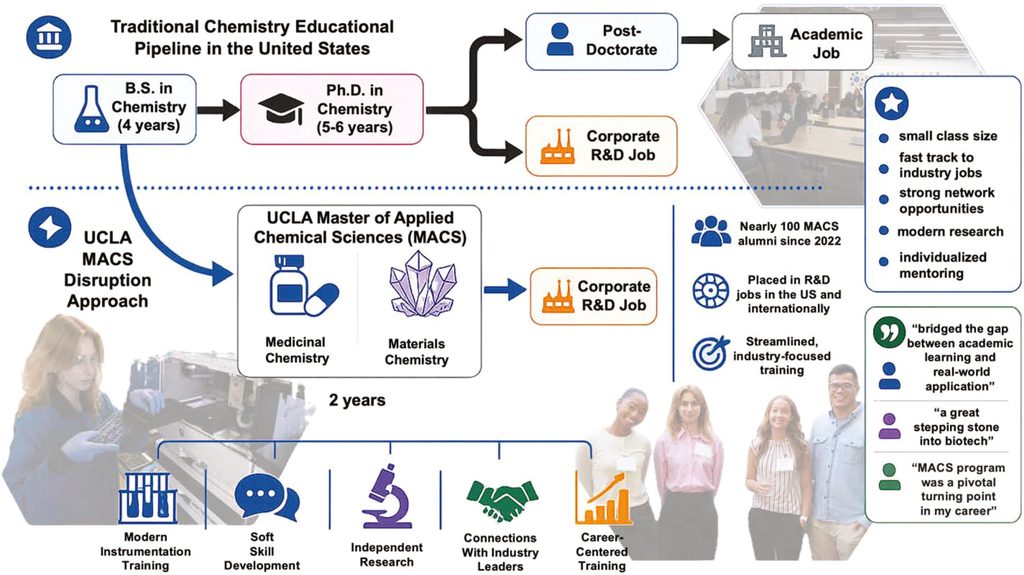
The article examines the need for graduate chemistry education that better prepares students for careers outside academia, and it describes how the MACS program addresses this need by combining advanced scientific coursework, hands-on laboratory training, professional development and direct engagement with industry.
Conceived by Spokoyny and Diaconescu around 2020 and launched in 2021 following University of California approvals, MACS was developed to provide an alternative to traditional Ph.D.-focused graduate education. The two-year professional master’s program prepares students for careers in areas such as medicinal chemistry, materials chemistry, biotechnology and other technology-driven industries.
The article details the program’s interdisciplinary curriculum, which includes specialized training in medicinal or materials chemistry, intensive laboratory modules reflecting industrial research practices, and coursework in data management, workflow optimization and science communication. Students also complete a year-long capstone research project in a UCLA laboratory or in collaboration with a local company.
An important component of the program is its emphasis on professional development and industry connections. Through the Careers in Chemistry seminar series, networking events, mentorship and the annual MACS symposium, students interact with professionals from corporate research and development, government, healthcare, patent law and other fields.
The authors also discuss the program’s outcomes and growth. Applications increased from 41 in the program’s inaugural year in 2022 to 80 for the 2025 cohort. According to the article, 86% of graduates secure employment or enroll in professional programs within six months of graduation, and nearly 100% are employed within one year.
The article further describes MACS’s self-supporting financial model, which does not rely on state-supported instructional resources. Program revenue is reinvested in shared departmental instrumentation and laboratory infrastructure, benefiting research and teaching across the department.
Looking ahead, the program is developing a new specialization in data science in chemistry and biochemistry to address the growing role of artificial intelligence, machine learning, and data-driven research in the chemical sciences.
Through their article, the authors present the UCLA MACS program as a model for professional graduate education that bridges the gap between advanced scientific training and the evolving needs of the workforce.
Penny Jennings, UCLA Department of Chemistry & Biochemistry, penjen@ucla.edu.