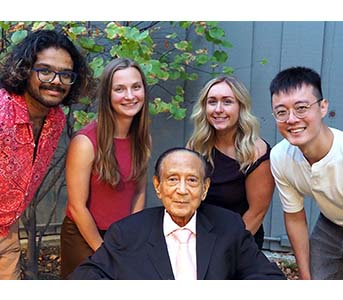
A research team led by Professor Bill Gelbart, including his Ph.D. student Daniel (Kyle) Taylor along with collaborator Professor Feng Guo of UCLA’s Department of Biological Chemistry, has been selected as one of a small group of Phase I winners nationwide of the NIH Common Fund’s Targeting RNA in Disease with Novel Technologies (TRDNT) Challenge.
The three-phase competition aims to accelerate the development, validation, and public dissemination of innovative RNA-targeting technologies that could lead to new classes of therapies. Phase I invited researchers to propose novel technologies and prototypes for targeting naturally occurring RNA involved in human disease. The NIH anticipates awarding up to $13.1 million in total prizes across the three phases, through 2027, with the goal of advancing and validating promising technologies.
The team’s winning proposal, “Self-amplifying miRNA, for mRNA knockdown,” focuses on using in vitro reconstituted virus-like particles to deliver self-replicating microRNA to silence oncogenes – genes that can drive cancer when they become overactive or mutate to function abnormally. This approach offers a promising new strategy for targeting genes involved in cancer progression by down-regulating their activity at the mRNA level.
The team will now advance to Phase II of the competition, which focuses on developing initial technology prototypes and demonstrating their potential through specific disease applications. This stage requires evidence of an initial prototype and a demonstration of how the technology could be used to target RNA associated with a human disease.
Professor Gelbart joined the UCLA Chemistry & Biochemistry faculty in 1975. Initially focusing on quantum mechanical theory of molecular photophysics, he later transitioned to statistical mechanical theory of complex fluids – liquid crystals, micellar solutions, high-molecular-weight polymers, and colloidal suspensions. About 25 years ago he made another major research pivot, moving into molecular biology and co-founding a lab with Professor Charles Knobler to study viruses. Their work helped establish the field of “physical virology” and advanced research on virus-like particles for RNA-based therapies.
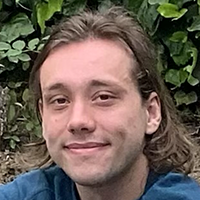
Kyle Taylor is a 4th-year PhD student who did his undergraduate work at Georgetown University and spent two years at the NIH working on the structure of immune cell receptors in the lab of David Margulies before starting in the Biochemistry, Molecular and Structural Biology (BMSB) graduate program at UCLA.
Because their project involved genetic fusion of an RNA replicase gene with microRNA sequence flanked by self-cleaving ribozymes, it was natural for Professor Gelbart and Kyle to join forces with Professor Guo, an expert on both microRNA and ribozymes who had come to UCLA from postdoctoral work with Professor Tom Cech, the Nobel-prize-winning discoverer of RNA enzymes – ribozymes – self-splicing RNA sequences.