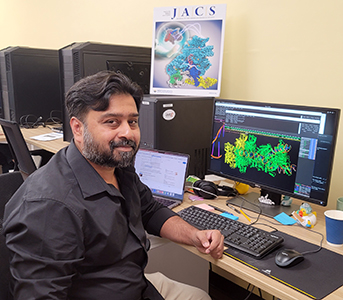
Dr. Mohd Ahsan, a postdoctoral scholar in Professor Giulia Palermo’s research group, has been selected as the sole recipient of the prestigious 2027 Theory & Computation Subgroup Postdoctoral Award from the Biophysical Society. His research combines advanced molecular simulations, statistical mechanics, and interpretable AI to uncover the fundamental principles governing complex molecular machines.
The award recognizes outstanding postdoctoral researchers who have made significant contributions to theoretical and computational biophysics. Ahsan was selected through a highly competitive international process involving researchers from the United States, Europe, and around the world.
Ahsan’s research focuses on developing innovative computational approaches that combine molecular simulations with interpretable artificial intelligence (AI) to understand the molecular mechanisms of complex biological systems. In particular, he has contributed to the development of graph neural networks (GNNs) and graph attention networks (GATs), powerful machine-learning approaches that can identify key molecular interactions and communication pathways governing the function of large biomolecular assemblies. Unlike conventional AI approaches that often operate as black boxes, these interpretable methods provide molecular-level insights into how biological systems function. By integrating graph-based AI with molecular dynamics (MD) simulations, Ahsan’s work establishes new strategies for identifying the structural and dynamical determinants of biological activity.
A particularly innovative aspect of Ahsan’s research is his effort to move beyond correlation toward causation in molecular simulations. While traditional analyses of molecular dynamics (MD) simulations largely rely on correlations between molecular motions, Ahsan has introduced Granger causality analysis to investigate the directionality of molecular communication and identify how changes in one region may influence others. This approach provides new insights into how molecular signals propagate through complex biological machines and regulate their function. The code for Granger causality analysis of MD simulations is freely available on GitHub.
A major application of these approaches is the study of CRISPR-associated transposons (CASTs), remarkable molecular machines capable of performing RNA-guided DNA integration. These systems offer exciting opportunities for developing next-generation genome-editing technologies that enable the targeted insertion of genetic material into DNA, a process known as gene knock-in. Working closely with fellow Palermo group researchers Dr. Chinmai Pindi has contributed to a broader research effort aimed at understanding how CAST systems assemble, communicate, and coordinate the molecular events required for precise DNA integration.
These advances have resulted in a recent publication in the Journal of the American Chemical Society, with additional research available as a preprint on bioRxiv, and on a review article recently published in Nature Structure and Molecular Biology. The computational methods developed through this work are openly accessible through the Palermo Laboratory GitHub repository, supporting their adoption by the broader scientific community.
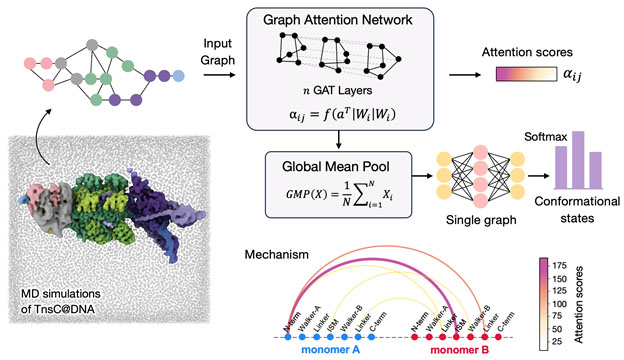
Ahsan’s recognition reflects the growing importance of combining physics-based molecular simulations with interpretable AI to advance our understanding of biological systems and accelerate the development of innovative genome-editing technologies.
The Biophysical Society is an international scientific organization dedicated to advancing biophysics through research, education, and scientific collaboration. Its Theory & Computation Subgroup brings together researchers developing theoretical and computational approaches to investigate biological systems across molecular and cellular scales.
Penny Jennings, UCLA Department of Chemistry & Biochemistry, penjen@ucla.edu.