
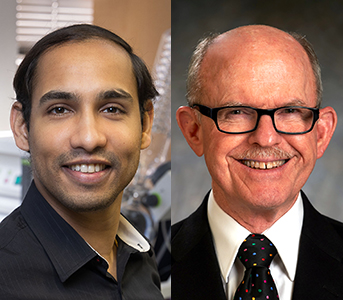
Key research by UCLA organic chemists Professor Soumitra Athavale and Distinguished Research Professor Kendall Houk on the mechanism of the Soai reaction was cited in the scientific background document for the 2026 Nobel Prize in Chemistry.
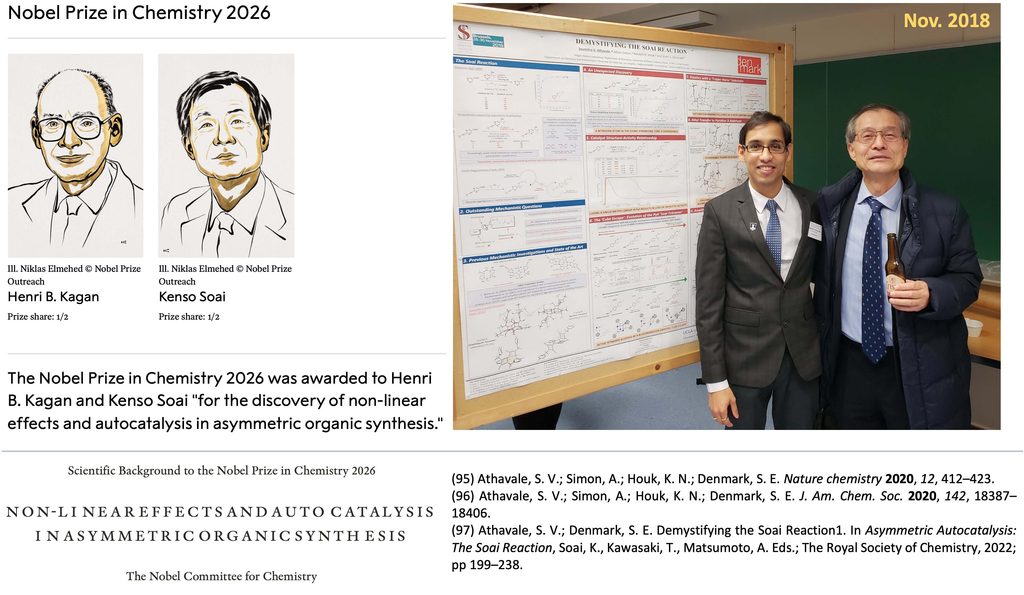
Awarded to Professor Emeritus Henri Kagan (Université Paris-Saclay) and Professor Emeritus Kenso Soai (Tokyo University of Science) for their discoveries involving nonlinear effects and autocatalysis in asymmetric organic synthesis, the prize recognizes advances in understanding how chemical reactions can favor one mirror-image form of a molecule over another.
Athavale’s connection to the Soai reaction began long before his doctoral research. As a teenager, he encountered the reaction in a past International Chemistry Olympiad problem set and was immediately captivated. As an undergraduate, he pursued the subject further during a summer internship at the Jawaharlal Nehru Centre for Advanced Scientific Research (JNCASR) in India, where he tracked down early papers on the reaction in the library.
“I dreamt of one day working on asymmetric autocatalysis and, perhaps, creating something even marginally as beautiful as what Prof. Soai had uncovered,” Athavale wrote in a social media post reflecting on the Nobel Prize.
That ambition led him to investigate the reaction’s mechanism as a doctoral student at the University of Illinois Urbana-Champaign, where he worked with organic chemist Scott Denmark. In collaboration with Houk’s UCLA research group, Athavale helped develop a mechanistic explanation for how the reaction amplifies one mirror-image form of a molecule. “I was so blown away because he was, chapter and verse, fluent in the intricacies and the literature on the Soai reaction,” Denmark recalls of his first meeting with Athavale. He agreed to mentor Athavale and even found money to fund the esoteric project. “Students like Soumitra Athavale come along only once or twice in an academic career. He is completely self-motivated, autodidactic, and passionate about science,” Denmark says. “He has the ambition, intellect, creativity, and experimental skill to achieve great things.”
Athavale was the first author of the decisive Nature Chemistry and JACS papers co-authored by Houk, Denmark and other researchers. These papers proposed a mechanism involving a four-unit zinc-containing catalyst, helping explain how the reaction produces an amplification of molecular chirality, solving a decades old mystery about the fascinating details of the mechanism of the Soai reaction.
Athavale credited Denmark with supporting his efforts to understand the reaction and acknowledged Houk and doctoral student Adam Simon for their collaboration.
“This was a mammoth computation to do with reasonably accurate quantum mechanics, and Adam Simon, then a graduate student, used Denmark’s computer cluster to get enough computer time to establish the details and energetics of the mechanism that Soumitra had suggested. Adam is now the Director of Computational Chemistry at QuantX Biosciences after several years at QuLab Inc. and Amgen,” said Ken Houk.
“I could not have asked for a better mentor than Prof. Denmark,” Athavale says. “He appreciated the importance of this problem, generously shared his extraordinary scholarship to keep me on track, and supported me with patience while giving me the independence to find my own way. I feel eternally lucky to have found him. I am also deeply grateful to Prof. Houk and Adam for the crucial computational insights that completed this story. I learned so much from Prof. Houk and was fortunate to find in him a second mentor, whose support has continued throughout my career.”
Athavale also recalled meeting Soai at the 2018 Solvay Conference on Chirality in Brussels, where he presented a poster on the research.
“The photograph here, taken with him in front of that poster, remains one of my most cherished scientific photographs and memories,” Athavale wrote.
For readers interested in learning more about the Soai reaction, Athavale recommended two foundational papers: the 1995 Nature report introducing amplifying asymmetric autocatalysis and a 2009 Science paper demonstrating asymmetric amplification triggered by carbon-isotope chirality.
“There is so much more to say about the extraordinary contributions of Prof. Kagan and Prof. Soai,” Athavale wrote. “But for the moment, I am simply grateful for the good fortune of having pursued science in the light of their fundamental discoveries and thrilled to see them receive this recognition.”
He concluded by congratulating both scientists on the honor.
Athavale’s connection to this year’s Nobel Prize was celebrated by a fan with a detailed cartoon on social media.
Penny Jennings, UCLA Department of Chemistry & Biochemistry, penjen@g.ucla.edu.


