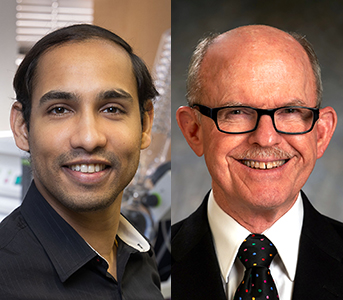
Distinguished Professors Steven Clarke and David Eisenberg each discussed their own award-winning research in a program titled “The Molecular Basis of Aging and Dementia,” presented during UCLA’s spring 2025 Emeriti Association dinner at the University Club. A video of their talks is now available to view.
From the UCLA Emeriti Association (by Stuart Wolpert):
Watch Dr. Steven Clarke and Dr. David Eisenberg discuss “The Molecular Basis of Aging and Dementia”
At UCLA’s spring 2025 Emeriti Association dinner, two outstanding UCLA professors — Dr. Steven Clarke and Dr. David Eisenberg — discussed their award-winning research in a program titled “The Molecular Basis of Aging and Dementia” at the University Club.
Dr. Clarke, a UCLA Distinguished Professor of Chemistry and Biochemistry and the former Director of the UCLA Molecular Biology Institute, has been honored by the American Chemical Society, the National Institutes of Health, the American Society for Biochemistry and Molecular Biology, and UCLA’s Academic Senate, which has awarded him the Eby Award for the Art of Teaching. His laboratory studies biochemical mechanisms that recognize age-damaged molecules in the body for their removal before they cause disease.
Dr. Eisenberg is UCLA’s Paul D. Boyer Professor of Molecular Biology, a former Director of the UCLA-DOE Institute for Genomics and Proteomics and Howard Hughes Medical Institute investigator, and member of both the National Academies of Sciences and Medicine. He is among the world’s most highly cited scientists, and studies the molecular basis of Alzheimer’s and Parkinson’s diseases and therapeutic approaches to potentially limit their pathologies.
Topics of this program included the biochemistry of aging; molecular damage and molecular repair in aging; Alzheimer’s disease and Parkinson’s disease; amyloid structure and pathology, and research by the laboratories of Dr. Eisenberg and Dr. Clarke in these and related areas.
Dr. Clarke began by describing how proteins accumulate spontaneous modifications, leading to dysfunctional molecules. Protein damage accumulates with age, impairing cellular function and setting the stage for neurodegeneration. He explained the role of specific repair enzymes in reversing age-related damage and suggested that a decline in their activity may underlie accelerated neural protein dysfunction. He discussed how cumulative molecular mistakes distort protein structure, impair neurotransmitter function, and exacerbate neuroinflammation — contributing to the onset of dementia. He emphasized that understanding these mechanisms opens possibilities for therapeutics aimed at increasing molecular repair.
Dr. Eisenberg discussed amyloids — protein aggregates that form characteristic fibrils in Alzheimer’s and Parkinson’s diseases. Amyloid fibrils arise from structured mis-folded proteins, often exacerbated by age-related chemical alterations. He described his landmark discovery that amyloid fibrils form a “steric zipper” where beta‑sheet strands interlock tightly, excluding water, to form stable fibrils. He discussed how post‑translational chemical alterations of amyloid precursor proteins can dramatically increase their propensity to aggregate or become toxic. These damaged forms accelerate plaque with age.
The scientists drew connections between age-related molecular damage and the pathological aggregation pathways central to dementia. Dr. Clarke explained how declining repair enzyme activity leads to accumulation of chemically damaged proteins. Dr. Eisenberg explained how such damaged proteins can undergo structural transitions into pathogenic fibrils.
Therapeutic strategies may include boosting molecular repair, inhibiting aggregation, and early biomarker detection. Dr. Clarke discussed the possibility of enhancing repair enzymes as a potential intervention. Dr. Eisenberg discussed research to block steric‑zipper fibril assembly using small molecules or peptides that bind amyloid surfaces and inhibit interlocking interactions. They discussed the potential of multi‑pronged approaches — combining enhancement of repair, prevention of aggregation, and early detection — and emphasized the importance of continued funding of molecular and genetic research, where progress is being made and can potentially benefit large numbers of patients.
After this spring dinner program, the federal government suspended hundreds of NIH grants to UCLA researchers, including two grants supporting Dr. Eisenberg’s research on the development of drugs for Alzheimer’s disease. He is currently seeking alternate sources of funding to continue his quest for a drug for Alzheimer’s disease.
Penny Jennings, UCLA Department of Chemistry & Biochemistry, penjen@g.ucla.edu.