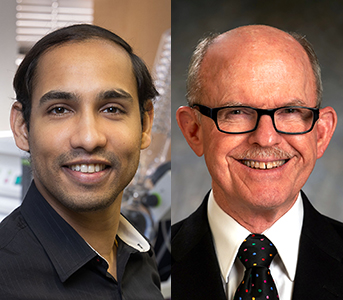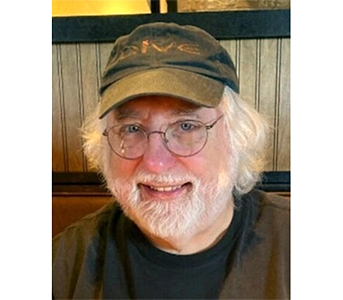
We are sad to report that Dr. Richard “Rich” Cross, a former postdoctoral fellow in Professor Paul Boyer’s laboratory and a longtime supporter of the department, passed away on February 7, 2026, at the age of 82.
A Distinguished Professor Emeritus at SUNY Upstate Medical University, Cross was internationally recognized for his contributions to the field of bioenergetics, the study of biological energy transfer and conversion at the cellular and molecular levels.
Born on August 26, 1943, in Hoboken, New Jersey, Cross received a B.A. in chemistry from Hartwick College and a Ph.D. in chemistry from Yale University in 1970. After earning his Ph.D., he completed postdoctoral research at UCLA with Professor Paul Boyer. Cross played an integral role in discoveries that contributed to Boyer receiving the 1997 Nobel Prize in Chemistry. In 1973, Cross joined the faculty of SUNY Upstate Medical University in the Department of Biochemistry and Molecular Biology.
In 2019, Cross established the Paul D. Boyer Summer Undergraduate Research Fellowship Fund at UCLA to honor Boyer. Thanks to his initial gift, along with support from Professor David Eisenberg and his wife, Lucy Eisenberg; former Boyer postdoctoral fellow Dr. Michael Gresser; the Boyer family; other friends and colleagues; and Xtandi royalties made possible by Professor Michael Jung, the endowment has funded 33 Boyer Fellowships since its inception.
“I know firsthand how important such a program can be for your career. Between my junior and senior year at a small liberal arts college, I was offered a research fellowship to work at the University of Rochester near my parents’ home,” said Cross in the announcement of the fellowship. “That summer I studied di- and tri-valent cation complexes with ATP, correlating the different structures with different rates of increase in cleavage of the beta-gamma phosphoric acid anhydride bond. We published our results in the Journal of the American Chemical Society. That publication was probably important in my gaining acceptance to Yale for graduate school. Also, when I arrived there, I decided that since I already knew something about cleaving ATP, it would be interesting to study how ATP is made. So, that summer fellowship sent me on a quest that would lead me to Paul’s lab and keep me busy for the rest of my career.”
“To put the impact of Cross’ generosity into perspective, back in 2018, our department was only able to award five summer fellowships,” said Vice Chair of Undergraduate Education Professor Jorge Torres at the recent departmental awards ceremony. “This year, thanks to Dr. Cross and many others like him who have supported our department, we are awarding over 30 summer fellowships. It is entirely due to this type of visionary support that we can provide life-changing opportunities to our young Bruins.”
To contribute to the UCLA Paul Boyer Summer Undergraduate Research Fellowship Fund in Cross’ honor, visit the giving website here.
From ASBMBToday (by Jessica Desamero):
Richard L. Cross, a researcher devoted to studying how adenosine triphosphate, or ATP, is made by the ATP synthase, died Feb. 7. He was 82. Cross was a longtime member of the American Society for Biochemistry and Molecular Biology and served on the editorial board of the Journal of Biological Chemistry for 24 years.
Born August 26, 1943, in Hoboken, New Jersey, Cross received his B.A. in chemistry from Hartwick College and his Ph.D. in chemistry from Yale University in 1970. After his Ph.D., he completed postdoctoral research at UCLA, in the lab of Paul Boyer, who later shared the Nobel Prize in Chemistry in 1997. In 1973, Cross joined the faculty of the State University of New York Upstate Medical University, in the Department of Biochemistry and Molecular Biology.
Cross played a key role in studying ATP synthase, the molecular motor enzyme that produces most cellular ATP. In 1973, Cross, Boyer and William Momsen published a paper that marked the beginning of the binding change mechanism, as Boyer later highlighted in his Nobel Prize lecture. In this work, they proposed: “In oxidative phosphorylation, energy from electron transport causes release of preformed ATP from the catalytic site. This release could logically involve energy-requiring protein conformational change.”
After establishing his lab, Cross co-authored two studies that provided critical support for a second key feature of the binding change mechanism: cooperativity between multiple catalytic sites. Later, his lab provided strong evidence for a third key concept: the cooperative, alternating action of three catalytic sites involves rotation of a central stalk subunit relative to the surrounding catalytic sites.
According to long-time departmental colleagues at SUNY Upstate, Patricia Kane, distinguished teaching professor, and Thomas Duncan, associate professor emeritus, Cross was an amazing mentor to faculty and students. He provided wise, fair and practical advice and had an unparalleled ability to encourage and inspire those he mentored to continually reach higher.
Cross is survived by his wife, Kathryn Davis; his daughter, Emily; and his brother, Greg.