Distinguished Professor Sarah Tolbert, the Charles and Carolyn Knobler Chair, received the International Mesostructured Materials Association (IMMA) Award for her significant lifetime contribution to mesostructured materials science and technology.
Tolbert received the award at the 13th International Mesostructured Materials Symposium (IMMS13), jointly organized by Inner Mongolia University, Fudan University, and the University of Shanghai for Science and Technology, held in Hohhot, China, in August.
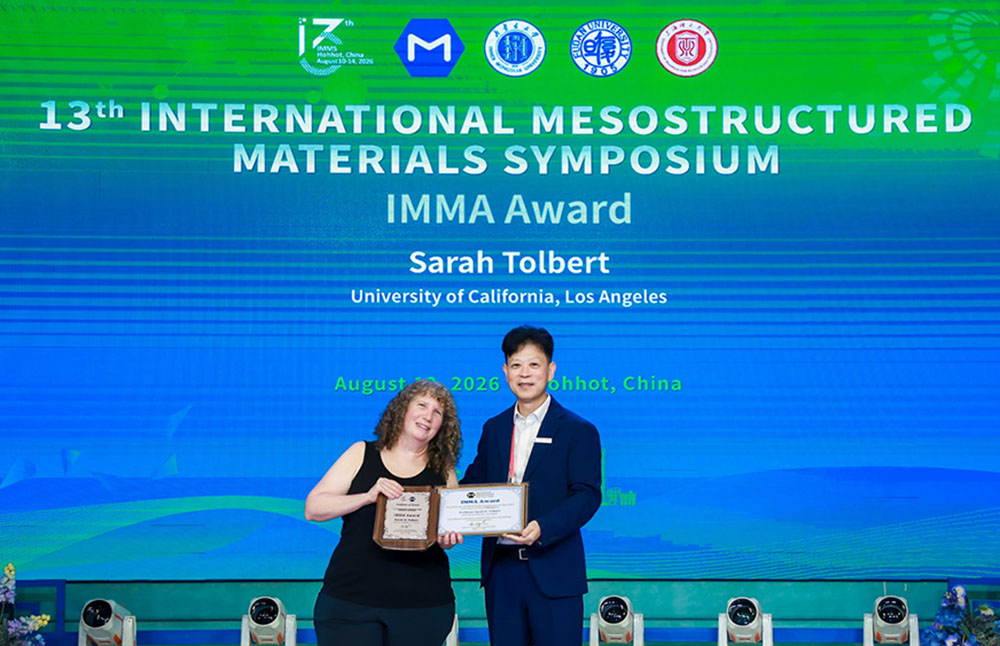
Tolbert has been a member of the UCLA faculty since 1997 and holds joint appointments in the Departments of Chemistry and Biochemistry, and Materials Science and Engineering. She is an internationally renowned materials chemist whose research spans a range of interdisciplinary areas, from battery systems to the design of ultrahard materials, and her work is recognized for its breadth, impact, and scholarly excellence.
The award recognizes Tolbert’s sustained contributions to the development of materials whose properties and functions are controlled by their architecture at the mesoscale—which ranges from approximately 2 to 50 nanometers. Her research has helped advance approaches for the design and synthesis of nanoporous and nanostructured materials and advance our understanding of how nanoscale architecture can be used to influence the physical properties of materials.
Tolbert’s connection to mesostructured materials began early in her scientific career. As a postdoctoral researcher at the University of California, Santa Barbara, she studied the synthesis, characterization and physical and structural properties of inorganic/organic composite and mesoporous materials with Professor Galen Stucky. She brought this expertise to UCLA when she joined the faculty in 1997.
A central theme of Tolbert’s research has been inorganic/organic co-assembly, in which amphiphilic organic species such as surfactants, block copolymers, or polymer colloids are combined with inorganic building blocks to create materials with controlled nanoscale porosity. Her group has developed methods to produce a broad range of mesostructured oxide, sulfide, and phosphate materials, as well as a variety of non-oxide porous semiconductors. These approaches allow researchers to tailor pore size, structure, and composition and, in turn, to tune the properties of the resulting materials.
An important aspect of Tolbert’s work has been connecting structure to function. Rather than treating nanoscale architecture simply as an aspect of making porous materials, her research has explored how controlling that architecture can produce desirable optical, electronic, magnetic, thermal, and electrochemical properties. This approach has allowed her research program to extend mesostructured-materials concepts into areas including energy storage, electronics, magnetic materials, and thermal management.
Her work on mesoporous materials has been particularly influential in energy storage, where Tolbert has investigated mesoporous transition-metal oxides and other nanoporous materials for both high rate and high capacity electrochemical charge storage. Her group has specifically explored mesoporous electrodes for applications in fast-charging batteries and supercapacitors, demonstrating how control over structure at the nanoscale can address practical challenges in energy materials. She has also exploited direct X-ray imaging methods to understand how the structure of mesoporous electrodes change during cycling in high capacity anode materials.
Her research has also demonstrated that mesostructural control can be used to tune properties beyond electrochemical performance. For example, her group has investigated how pore size and nanoscale architecture affect thermal conductivity in mesoporous silica materials, with potential applications in thermal insulation and passive cooling.
Tolbert’s longstanding commitment to the field also includes leadership within the international mesostructured-materials community. In 2018, she served on the organizing committee for the 10th International Mesostructured Materials Symposium, which was held at UCLA. The symposium brought together researchers studying materials in which nanoscale architecture plays a dominant role in controlling properties and function, including applications in catalysis, separations, drug delivery, energy harvesting, and energy storage.
Today, controlling structure across multiple length scales remains a defining feature of Tolbert’s research program. Her group uses solution-phase and solid-state methods to control materials structure from the atomic to the nanometer scale, and then uses that structural control to tune properties for a broad range of applications. The IMMA Award recognizes the breadth and lasting impact of this work: a career devoted to understanding how precisely controlled nanoscale architecture can create new materials and new functionality.
Penny Jennings, UCLA Department of Chemistry & Biochemistry, penjen@g.ucla.edu.