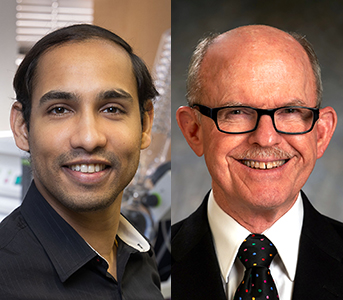
Professor Prineha Narang, the UCLA Howard Reiss Chair, is leading a team of researchers developing new artificial intelligence approaches for controlling complex quantum systems.
The research, a collaboration with Caltech and NVIDIA, uses an AI model to design laser pulse sequences for a molecule up to 10 million times faster than conventional simulation.
Narang’s blog explaining the result in more detail can be viewed here.
From the UCLA Division of Physical Sciences:

UCLA researchers leverage AI-for-science to accelerate control of complex quantum systems
Collaboration with Caltech and NVIDIA uses an AI model to design laser pulse sequences for a molecule up to 10 million times faster than conventional simulation
Researchers at UCLA, working with scientists at Caltech and NVIDIA, have developed an artificial intelligence-based approach that can dramatically accelerate one of the central challenges in quantum science: figuring out how to precisely control a complex quantum system.
Led by UCLA faculty member Professor Prineha Narang, the team trained an AI model to learn the quantum dynamics of a real molecule. The model could then be used to design sequences of laser pulses that steer the molecule into a desired quantum state.
The approach produced predictions up to 10 million times faster than the already GPU-accelerated numerical simulations on which the model was trained. The work was highlighted by NVIDIA at IEEE Quantum Week in Toronto as part of the company’s release of new technologies for developing fault-tolerant quantum computing applications.
Before molecules can be used for applications such as precision spectroscopy or quantum information processing, researchers need to place them into specific, well-defined quantum states. Doing that requires carefully controlling the system, often through sequences of laser pulses.
For relatively simple quantum systems, researchers can simulate the effects of different pulses and determine which sequence works best. But the problem becomes much harder as systems grow more complex. Every possible pulse must be evaluated by simulating how it affects the system’s quantum dynamics, and the computational cost can grow exponentially.
“Leveraging NVIDIA accelerated computing and the CUDA-Q platform gives us the computational power to study the physics at a scale that would otherwise be extremely difficult,” said Narang. “Combining that capability with the ideas coming from UCLA and Caltech allows us to ask much more ambitious questions about how complex quantum systems can be controlled.”
“AI and Accelerated computing is transforming our understanding of how quantum technologies work and how we can improve them,” said Sam Stanwyck, Director of Quantum Product at NVIDIA, “This work with UCLA and Caltech shows that when given access to the latest developments in AI infrastructure, researchers can push beyond what’s currently possible for quantum technologies.”
The researchers tested their approach using hydronium, a molecular ion composed of three hydrogen atoms and one oxygen atom. Hydronium is particularly interesting to physicists because some of its quantum transitions are sensitive to possible variations in fundamental constants, making the molecule a potential tool for searching for physics beyond the Standard Model.
But hydronium is also difficult to control. Even when cooled to 20 kelvin — about minus 424 degrees Fahrenheit — a trapped hydronium ion can occupy hundreds of rotational and hyperfine energy levels. Researchers must find a sequence of laser pulses capable of funneling that distribution into a single target state.
Rather than repeatedly running a full quantum simulation while searching for the right sequence, the team trained a type of AI model called a Fourier Neural Operator, or FNO, using GPU-accelerated simulations generated with NVIDIA CUDA-Q Dynamics.
Unlike a large language model (LLM), which learns statistical relationships in language, the FNO was trained directly on the physical behavior of the quantum system. Given the molecule’s current state and the properties of a laser pulse, it learned to predict how the molecule’s population would evolve.
Once trained, the FNO essentially became a much faster stand-in for the full simulator. In the researchers’ 888-dimensional model of hydronium, it reproduced the reference quantum dynamics while making predictions up to 10 million times faster than the GPU-accelerated simulation used to generate its training data.
Using the method, the researchers produced sequences that achieved a target-state population of 0.98 with a success rate of up to 86.2%. Compared with a reinforcement-learning approach operating in the same control space, the new method roughly doubled the success rate, used about half as many laser pulses and reduced the time required to generate a sequence from approximately 10 hours to between 10 and 20 minutes.
The work also illustrates a different role for artificial intelligence in science. Rather than asking an AI system to reason about physics from scientific literature or other text, researchers can train models directly on the mathematical behavior of physical systems.
“While LLMs have shown how powerful AI can be when it learns the structure of language, in AI-for-science we need a different approach,” Narang said. “For problems like this, we want models that learn the structure of the underlying physics itself. Once a model can do that, it becomes a tool not just for predicting what a quantum system will do, but for designing how we want it to behave.”
The researchers say the same general strategy could be applied beyond hydronium. Other molecular ions and quantum technologies face similar problems as their state spaces become too large for traditional optimization methods. Fast, physics-informed surrogate models could allow researchers to search those spaces and design control protocols that previously would have been computationally impractical.
The research is a collaboration among UCLA’s NarangLab, NVIDIA and Caltech, leveraging the NVIDIA CUDA-Q platform. Authors are Anastasia Pipi, Valentin Duruisseaux, Emily Been, Xuecheng Tao, Taylor L. Patti, Anima Anandkumar and Prineha Narang. This work is generously supported by the Gordon and Betty Moore Foundation and the U.S. Department of Energy. The team is proud to be a part of the Genesis Mission of the Department of Energy. The study, “Inverse Design of Quantum Control Sequences with Fourier Neural Operators,” is available on arXiv.
Penny Jennings, UCLA Department of Chemistry & Biochemistry, penjen@g.ucla.edu.