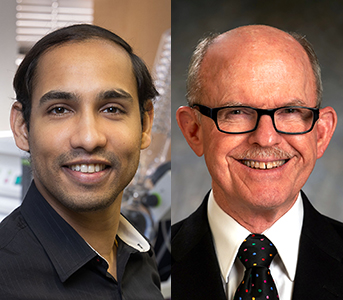
Professor Matthew Nava has received a Faculty Early Career Development (CAREER) award from the National Science Foundation.
“I am extremely grateful for the support provided by the National Science Foundation as well as the hard work and dedication provided by members of the lab,” Nava said. “I look forward to pushing the boundaries of base metal and main-group catalysis in addition to enhancing the educational mission of the university.”
The CAREER Awards are NSF’s most prestigious awards in support of early-career faculty who have the potential to serve as academic role models in research and education and to lead advances in the mission of their department or organization.
The award will support Nava’s efforts to develop new ways to transform the basic building blocks of chemicals into valuable products including medicines, agrochemicals, material precursors, and chemical fuels. Currently, many essential chemical reactions require the use of rare and expensive “noble” metals, which can be difficult to extract, and subject to supply chain disruptions when sourced from geopolitically sensitive regions. This project seeks to replace these critical metals with common, inexpensive and earth-abundant elements molecularly engineered to perform at the same high level as their noble metal counterparts. A key enabling feature of this work is the use of supporting ligands to compensate for deficiencies of base elements. By making chemical manufacturing cleaner, more affordable, and hardened against supply chain disruptions, this work would strengthen advanced manufacturing in the U.S., while also increasing our economic competitiveness and security. Beyond the laboratory, the project will provide unique training opportunities for undergraduate students, equipping them with the technical skills needed for the modern workforce and creating publicly available tutorials to make applied chemical synthesis available to everyone.
The proposed research will investigate the role of metal-ligand cooperativity in bond activation processes through the development of modular synthetic platforms. Specifically, the project would focus on the synthesis of metal aminoxide and related scaffolds designed as metal-based analogues of organic 1,3-dipoles. These complexes will be used to interrogate the fundamental design parameters required to unlock the activation of strong C–H bonds using abundant main-group elements and first-row transition metals. Through detailed structure-function studies and physical characterization, the research will seek to elucidate the individual electronic contributions of the dipole components, which have been historically difficult to decouple. The project will evaluate the ability of these dipolar systems to enable reversible sp2 and sp3 C–H bond activation processes and subsequent functionalization under mild conditions. Ultimately, these molecular design concepts are expected to be broadly applicable to many elements across the periodic table and provide alternative and orthogonal routes to chemical processes that traditionally require precious metals.
Nava joined our inorganic faculty in July 2022 as the Jeffrey and Helo Zink Endowed Professional Development Term Chair in Chemistry. A Southern California native, he received a bachelor’s degree in biochemistry as a Maximizing Access to Research Careers (MARC) U*STAR Program trainee and his master’s degree in chemistry from the University of California, Riverside, working with Professor Chris Reed. He received his Ph.D. in chemistry in 2017 from the Massachusetts Institute of Technology with Professor Christopher Cummins on Lester Wolfe and Alan Davison Fellowships. Before joining the UCLA faculty, Nava was a joint postdoctoral fellow in Professors Daniel G. Nocera’s and Daniel Kahne’s groups at Harvard.
Nava’s awards and honors include a Scialog: UCLA Society of Hellman Fellows (2025), Sustainable Minerals, Metals, and Materials Fellowship (2024), and American Chemical Society (ACS) Petroleum Research Fund Doctoral New Investigator (DNI) Grant (2024).
Penny Jennings, UCLA Department of Chemistry & Biochemistry, penjen@g.ucla.edu.