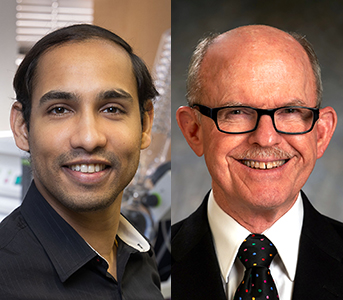
Last year, the UCLA Molecular Instrumentation Center (MIC) in the Department of Chemistry & Biochemistry opened its newest lab, the High-Throughput Synthesis and Catalysis Facility (HTSC), and began working with research groups interested in incorporating automated high-throughput experimentation (HTE) into their projects.
HTE has garnered increasing attention over the past few decades for its ability to accelerate reaction discovery and optimization. It enables the screening of a broad parameter space within a single experiment, generating high-volume datasets particularly well suited for machine learning and artificial intelligence models. Additionally, HTE systems can reliably and reproducibly scale down to micromole quantities, reducing cost and material consumption while increasing the number of experiments per unit of material.
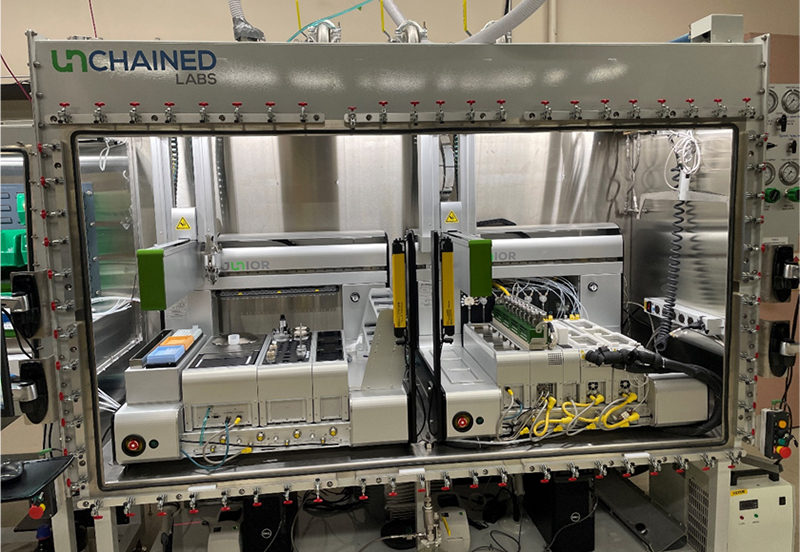
The facility houses two systems from Unchained Labs designed to automate organic synthesis and catalysis, with flexibility to customize and adapt to a range of synthetic workflows. Spearheaded by Professor Abigail Doyle, these systems were acquired through an NIH High-End Instrumentation Proposal to expand the department’s capabilities in automated chemical synthesis. The robotic instruments reside in an inert purge box, and are capable of automating both solid and liquid handling, as well as reaction processing. Software for designing, executing, and analyzing HTE screens on the Unchained systems is also available.
Specifically, the HTSC’s instrumentation can automate solid (as low as 1 mg) and liquid (as low as 1 µL) handling across multiple plate formats, ranging from 2×1 (2 wells, 125 mL) to 8×12 (96 wells, 1 mL). A wide range of customizable parameters governing solid and liquid handling can be optimized to ensure accurate and reproducible reagent dispensing. Reaction processing capabilities include heating, cooling, vortexing, stirring, and filtration, with additional units available for high-throughput photochemical and electrochemical processing. The HTSC’s automated instrumentation can also accommodate high-pressure chemistry with independent control of stirring, pressure, and temperature, allowing for injection and sampling under pressurized conditions for reaction monitoring. The facility additionally includes a vacuum concentrator and an LCMS with fraction collection capabilities for analysis and purification.
Interested labs have several options for exploring HTE in their research. Facility staff are available to meet to discuss capabilities and to help plan and execute HTE campaigns. Researchers may choose to have staff fully manage the setup, execution, workup, and analysis of high-throughput screens, or they may be trained to operate the instruments independently. Training on the HTE systems is highly modular and can be tailored to each user’s needs.
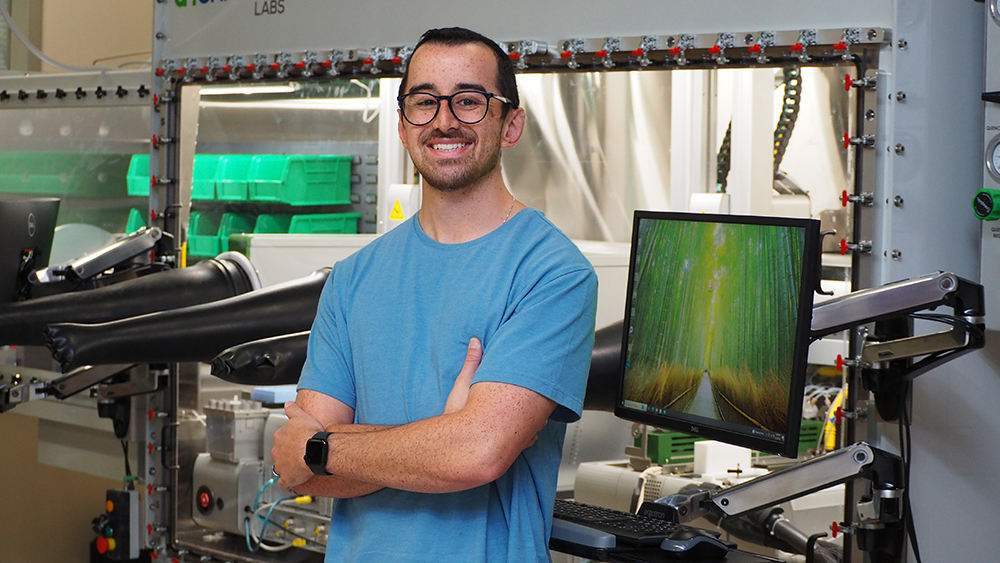
For more information, please contact Brandon Jolly (jollyb@ucla.edu) to discuss incorporating high-throughput experimentation into your research.
About the UCLA Molecular Instrumentation Center (MIC)
The UCLA Molecular Instrumentation Center (MIC) in the Department of Chemistry & Biochemistry is open to UCLA researchers, other academic institutions, and commercial enterprises. MIC encompasses sixmajor areas: Magnetic Resonance, Mass Spectrometry, X-ray Diffraction, Materials Characterization, Electron Microscopy, and High-Throughput Synthesis. Learn more here.