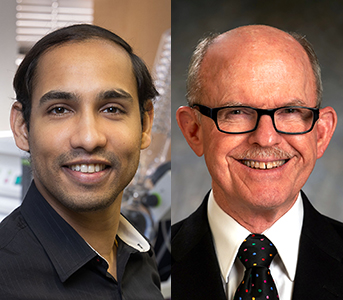
Professor Justin Caram is featured in a recent Popular Science article, “How Do Erasers Actually Work? It’s Surprisingly Complicated,” explaining the molecular science behind one of the world’s most familiar classroom tools.
In the article, Caram describes how graphite – the material used in pencil “lead”- is made of stacked layers of graphene held together by weak intermolecular attractions known as van der Waals forces. These same weak forces allow graphite to adhere to paper, while an eraser forms an even stronger attraction to the graphite, lifting it from the page. He also explains why ink is much more difficult to erase because it penetrates into the paper’s fiber network rather than remaining on the surface.
The article highlights how everyday objects such as pencils and erasers illustrate fundamental concepts in chemistry and materials science.
Read the full Popular Science article: How do erasers actually work? It’s surprisingly complicated
A UCLA Chemistry & Biochemistry faculty member since 2017, Caram’s research group explores how molecules and materials interact with light, particularly through the study of exciton transport and system-bath interactions. His work blends chemistry, physics, and engineering, contributing to advances in quantum science.
He is a founding member of the Center for Quantum Science and Engineering (CQSE), an interdepartmental program focused on advancing education for scientists and engineers in quantum-enabled technologies, including the development of a terminal master’s degree program in quantum engineering.
In recent years, Caram has been named a 2025 Gordon and Betty Moore Foundation Experimental Physics Investigator, received the inaugural 2026 Research Corporation for Science Advancement (RCSA) Bridge Award, earned the 2024 Richard P. Van Duyne Early Career Award in Experimental Physical Chemistry, received the 2023 Journal of Physical Chemistry Lectureship Award, was awarded a 2023 Sloan Research Fellowship, and was honored with the 2022 Camille Dreyfus Teacher-Scholar Award.
Penny Jennings, UCLA Department of Chemistry & Biochemistry, penjen@g.ucla.edu.