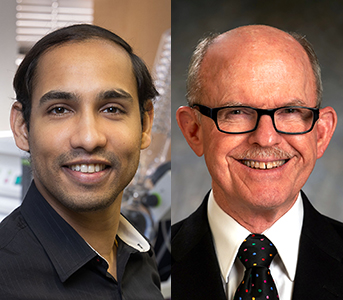
Professor Kendall Houk and graduate students Alexander Maertens and Qingyang Zhou collaborate with Professor Grace Han’s group at University of California, Santa Barbara (UCSB), to design a system that captures solar energy and releases heat on demand through catalytic activation. Its reversibility makes it a promising candidate for sustainable heating applications such as water heating and cooking, potentially replacing conventional heating oil.

The team has designed the pyrimidone-based molecular solar thermal energy storage (MOST) system capable of storing a record-breaking 1.65 MJ/kg of energy, exceeding the energy density of a lithium-ion battery at 0.9 MJ/kg.
Their work was recently published in the journal Science and was featured on the journal’s cover on April 23, 2026. Maertens, a third-year Ph.D. student, and Zhou, a fourth-year Ph.D. student in Houk’s group, are co-authors of the study.
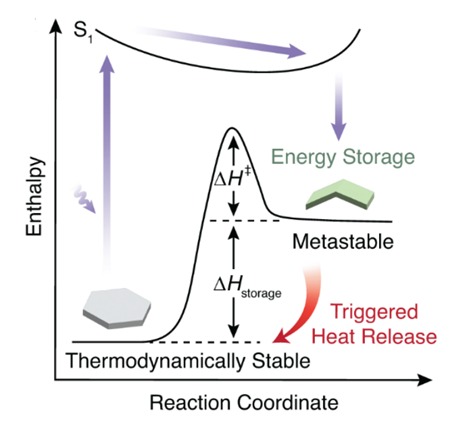
The magic of MOST molecules relies on the reversible interconversion between different molecular forms through photoisomerization. In this process, solar energy transforms the molecule into a strained, metastable isomer that stores energy. Upon catalytic triggering, the molecule reverts to its thermodynamically stable form, releasing the stored heat (Figure 1). Larger energy differences between the stable and metastable states correspond to higher energy storage densities, which often flavors small moleculeswith highly strained metastable structures. Among the systems studied, Dewar isomerization, which involves a photo-induced loss of aromaticity, has emerged as a particularly promising strategy for maximizing energy storage density.
Despite their promise, MOST systems face several practical constraints. Functionalization is often required to improve UV-light absorption, but these modifications typically reduce gravimetric energy density. In addition, many MOST systems operate only in organic solvents and are incompatible with water-based environments, limiting their practicality for sustainable heating applications.
The Han research group at UCSB, which specializes in MOST energy storage,drew inspiration from DNA photochemistry. Under sunlight exposure, nucleobases in DNA can undergo a sequence of reactions to form a 2-pyrimidone derivative and subsequently a Dewar isomer. Nature has evolved photolyase enzymes that catalyze the conversion of these Dewar isomers back to the thermodynamically stable 2-pyrimidone form.
Inspired by this mechanism, the experimental team engineered four pyrimidone derivatives with different substituents (Figure 2). To better understand the reaction mechanism and optimize molecular design, they collaborated with the Houk research group at UCLA, which specializes in computational studies of pericyclic reactions and had previously collaborated with the team.
“With modern quantum mechanical computations and powerful computers, we can compute the energetics and detailed pathways of both the photochemical and thermal processes,” Houk noted. “These computations also allow us to predict substituents that might work better, which the Han group can then try to synthesize and see if the process can be improved further.”
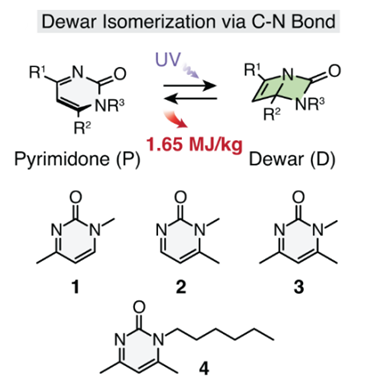
Among the four pyrimidone derivatives, molecule 3 exhibited the highest gravimetric energy storage capacity.
“There are two key molecular design aspects that we identified as being critical to the remarkable performance of this MOST system,” Maertens explained. “First, the photoinduced conversion to the Dewar isomer results in a total loss of aromaticity, forming two highly strained rings that store substantial energy in a strategic C–N bond. Second, the incorporation of lightweight methyl (CH3) groups lowers the barrier for efficient, rapid release of the stored heat from the Dewar isomer while maximizing gravimetric energy density.”
The team demonstrated the system’s remarkable heat-release capability by successfully boiling 0.46 mL of water using 107 mg of the Dewar isomer of molecule 3 (D-3).
The MOST system also demonstrated long-term chemical and thermal stability over multiple energy storage and release cycles, with the Dewar isomer remaining stable for more than a year in DMSO solution.
Building on this proof-of-concept study, the researchers plan to further optimize the system’s chemical properties.
“Our groups seek to design and make new MOST molecules with even higher energy densities,” Houk said. “The Han group has ideas for other molecules to try, and we are using our computations to test these ideas and save them some experimental time. We are also developing a machine learning model to predict new heterocyclic systems and substituents that will produce molecules that absorb a broader spectrum of sunlight and produce even higher energy molecules.”
Article by Zhuoying Lin, zylin@g.ucla.edu.