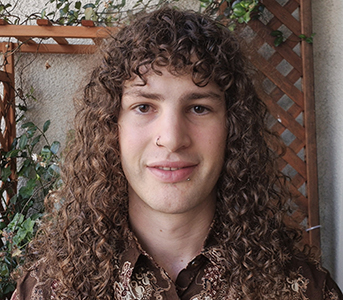
First year Materials and Nanoscience graduate student Stéphane Miaule (Tolbert group) has been awarded the 2026 National Defense Science and Engineering Graduate (NDSEG) Fellowship, one of the country’s most prestigious honors for graduate students in the fields of Science, Technology, Engineering and Math (STEM).
The program, jointly sponsored by the U.S. Army, Navy, and Air Force, supports doctoral students across a broad range of scientific and technological fields of strategic importance. This highly competitive fellowship provides full tuition, fees, and a monthly stipend for three years. In 2026, only 102 fellowships were awarded nationwide, and Stéphane is the only UCLA graduate student to receive the award this year.
Before transferring from Santa Monica College to UCLA, Stéphane interned at NASA’s Kennedy Space Center and Marshall Space Flight Center, where he researched the mechanical and thermodynamic properties of lunar regolith, as well as radiation shielding materials for lunar habitation development. At UCLA, he joined the Soft Materials Research Laboratory under Professor Qibing Pei, focusing on the synthesis and characterization of hafnium oxide nanocomposite scintillators. After earning his bachelor’s degree in chemistry, he remained in the Soft Materials Research Laboratory as a post-baccalaureate researcher for one year before joining Professor Sarah Tolbert’s group as a Ph.D. student.
Stéphane’s Ph.D. research is focused on improving the properties of conjugated polymers, which are a family of plastic materials that can conduct electricity. Stéphane is specifically looking at self-assembling polymers that can be processed in water to create light-weight, flexible, high-conductivity polymer devices without the need for toxic or volatile organic solvents.
After completing his Ph.D., Stéphane hopes to work in a national laboratory, researching semiconducting polymers for applications in new electronic devices.
“The Graduate (1967) featured a memorable scene in which the protagonist was told that ‘there’s a great future in plastics.’ We know this still holds true today, as polymer research has expanded rapidly due to the wide variety of applications these materials enable. Through my work on semiconducting polymers, I hope to contribute to the continued development of plastic electronics,” Stéphane said.
Penny Jennings, UCLA Department of Chemistry & Biochemistry, penjen@g.ucla.edu.