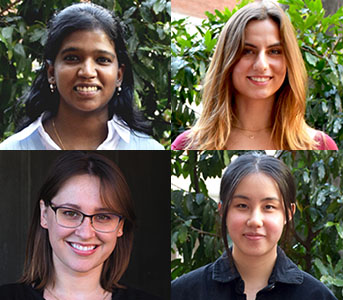
Professor Giulia Palermo has been awarded a highly prestigious Early Stage Investigator Maximizing Investigators’ Research Award (ESI MIRA) R35 grant from the National Institutes of Health / National Institute of General Medical Sciences. This award will support the Palermo Lab’s efforts to develop and integrate advanced molecular simulations and artificial intelligence (AI) approaches to uncover the molecular mechanisms underlying CRISPR-Cas9 genome editing and guide the rational design of more efficient and precise genome-editing technologies.
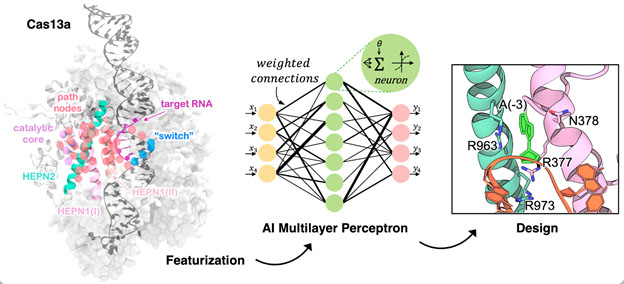
The Palermo group is internationally recognized for its pioneering computational studies of CRISPR-Cas genome-editing systems. By developing and integrating cutting-edge molecular simulations and artificial intelligence (AI) approaches, the lab seeks to uncover the molecular mechanisms underlying genome editing and guide the rational engineering of next-generation technologies with transformative potential for the life sciences. Recent research published in the Journal of the American Chemical Society demonstrates how interpretable AI approaches can reveal the molecular mechanisms governing DNA recognition by CRISPR-associated proteins. For a broader perspective on the lab’s research at the intersection of computational biophysics, AI, and genome editing, see Palermo’s recent review in Nature Structural & Molecular Biology.
Palermo is a Camille Dreyfus Teacher-Scholar and has received several prestigious honors, including the Corwin Hansch Award for Outstanding Scientists Under 40, the NSF CAREER Award, the Sloan Research Fellowship in Chemistry, and recently the 2026 Theoretical Chemistry Institute Hirschfelder Visitor, University of Wisconsin Madison.
Palermo joined the UCLA faculty as a full professor on July 1, 2026. Her research group relocated with her from the University of California, Riverside, where she was a Professor of Bioengineering and Chemistry.
The MIRA program supports investigators’ overall research programs through a single, unified grant rather than individual project grants. Its goal is to provide investigators with greater stability and flexibility, thereby enhancing scientific productivity and increasing the potential for important breakthroughs.